Active Now
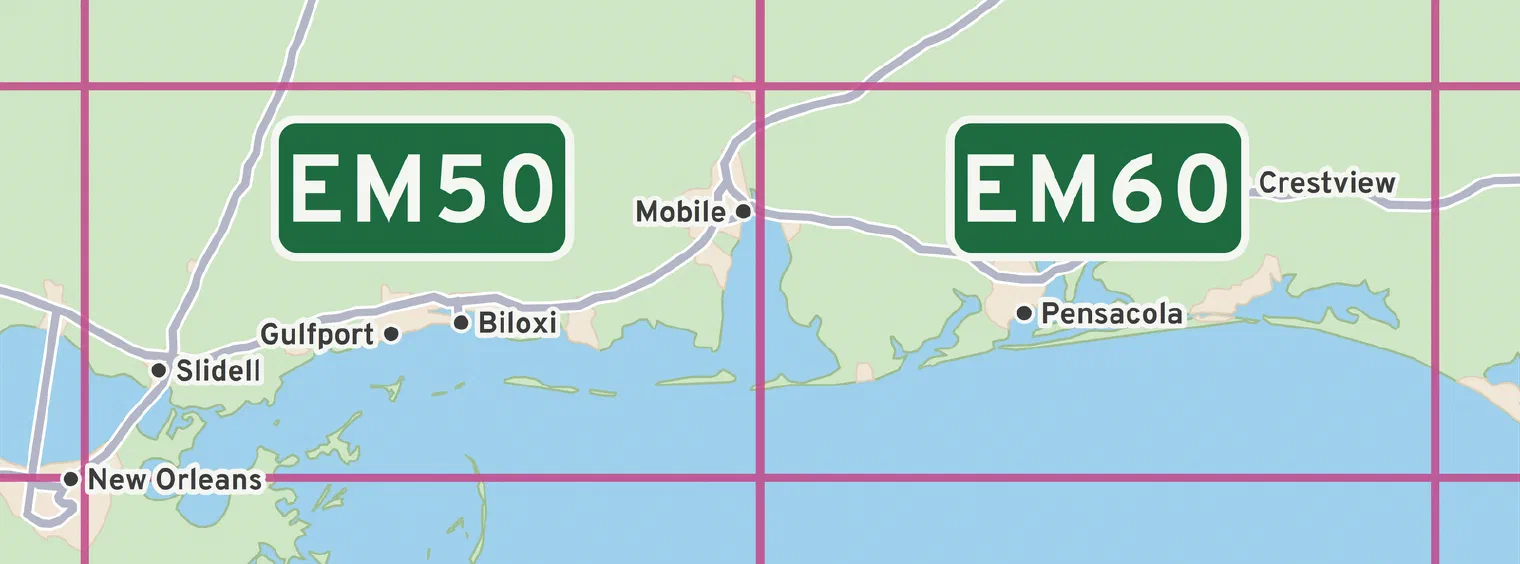
Both boards cover grid squares EM50 and EM60 only.
Data collected 2026-10-10T00:10:01Z, 0 min before this page was built. Refreshed about every five minutes.
On the air now — POTA parks
No park activations spotted in EM50 or EM60 right now.
Being heard — any station, digital only
1343 reception reports in the last 60 minutes — 1022 transmitted out of the grids, 320 heard into them, and 1 between two stations both inside them. A different cut of the same total: 3 of those reports were on bands outside the list below, so they are counted here but appear in no row of it.
| Band | Reports | Best path | Distance | Mode |
|---|---|---|---|---|
| 160m | 0 | no reports in the last hour | ||
| 80m | 2 | KK4NDU (EM60) → KD2M (EL87) | 344 mi regional | WSPR |
| 60m | 0 | no reports in the last hour | ||
| 40m | 6 | N4WLO/1 (EM50) → N3AGE-0 (FN30) | 1097 mi | WSPR |
| 30m | 491 | N4LR (EM50) → VK6YNE (OF76) | 11030 mi | FT8 |
| 20m | 746 | AG5WY (EM50) → VK6RZ (OF77) | 10984 mi | FT8 |
| 17m | 50 | KK4NDU (EM60) → VK5ARG-2 (PF95) | 9789 mi | WSPR |
| 15m | 33 | LU2ETR (GF05) → KJ6NA (EM60) | 4888 mi | FT8 |
| 12m | 8 | 3D2USU (RH82) → KR4SO (EM50) | 7067 mi | FT8 |
| 10m | 4 | W4WLO (EM50) → VK4MA (QG64) | 8734 mi | FT8 |
| 6m | 0 | no reports in the last hour | ||
How to read this
On the air now is POTA only. It lists people activating one of the parks in EM50 and EM60, and nothing else — a home station calling CQ two miles away, a contest operation, or somebody portable outside a park will never appear here, however loud they are. Spots come from three places: the activator posting their own, a hunter posting one after working them, or an automated skimmer, which decodes CW and cannot hear phone at all. In one snapshot of 103 spots nationwide on 8 August 2026, 27 were the activator’s own and 76 were somebody else’s — one reading on one afternoon, not a rule. Either way, a spot says somebody was on that frequency at that moment.
Being heard comes from PSK Reporter: reception reports from the past hour where one end of the path was inside EM50 or EM60. Any station counts, park or not. A report exists only after a receiving station decoded the signal and reported it, so it is evidence the signal actually arrived somewhere.
That table is a digital-mode picture, not a whole-band picture. PSK Reporter is fed by decoding software, so it carries FT8, FT4, WSPR, JS8 and the like. Phone is not machine-decoded, so it does not appear there at all. Somebody can be working SSB, be heard across the country, and leave no trace whatsoever on the band table. Read it as what the digital modes are doing — which, if you watch PSK Reporter for six metres, means you are watching six metre FT8.
That is why the two lists disagree, and the disagreement is the useful part. A station calling CQ that nobody has copied yet shows up in the first list and not the second — and so does anyone on phone.
Reception reports also depend on somebody nearby running a receiver that reports to PSK Reporter. When nobody is, this page cannot tell a quiet band from an unwatched one.
Best path means the longest one, and nothing else. For each band it is the single report in the hour above with the greatest distance between the two stations — not the strongest signal, not the most reliable path, and not a two-way contact. Read the arrow as transmitted → heard: the station on the left was decoded by the station on the right. Either end can be the one in EM50 or EM60, so a row may be somebody hearing us or us hearing them, and on a quiet band both ends can be local. One report at one moment sets the row, so a long path means it happened once — not that the band held it for the hour.
Grid squares are shown to four characters. PSK Reporter publishes finer locators than that. They are trimmed here deliberately, because a six or eight character locator can pinpoint somebody’s home.
A spot records that somebody was on that frequency at that moment. The operator may have moved band or finished by the time you read this, and an activator nobody has spotted does not appear at all.
Six metres, wider view: 3 reception reports across 5 grid squares of the EM field — roughly the south-east — in the last hour, the nearest about 300 miles away in EM74. That is close enough to be worth a listen even though the row above shows nothing local. Six metre openings are patchy, and that row only knows what somebody nearby happened to be decoding.
Every HF band, plus six metres, is listed in the same order every time, whether or not anything was reported on it, so a quiet band is visible rather than simply absent. Anything outside that list gets no row — VHF and above, and also the occasional report whose frequency does not land in any band this page recognises. Those are still counted in the total above and called out there rather than quietly dropped. “No reports” means nobody reported — which can mean the band was shut, or that nobody nearby was listening to it on a digital mode. This page cannot tell those apart. “Regional” is a display threshold, not a propagation verdict: it marks a best path under 500 miles, far enough to be worth noting and short enough that calling it the band’s reach would mislead. What actually carried it — groundwave, NVIS, short skip or an ordinary single hop — depends on the band, and this page does not attempt to say. Distances are great-circle, computed from the full locators PSK Reporter reports, which are finer than the four-character grids shown here; a locator still describes a square rather than a point, so treat every figure as approximate. A long path on 6 metres is often sporadic-E, though near solar maximum F2 can do it too, and nothing here distinguishes them.
Spots via POTA. Reception reports via PSK Reporter. See also the EM50/60 leaderboards and POTA DX on the Air.